August 12, 2026
Salesforce Deployment Best Practices: 20-Step Checklist
Salesforce Deployment Best Practices Salesforce deploy...
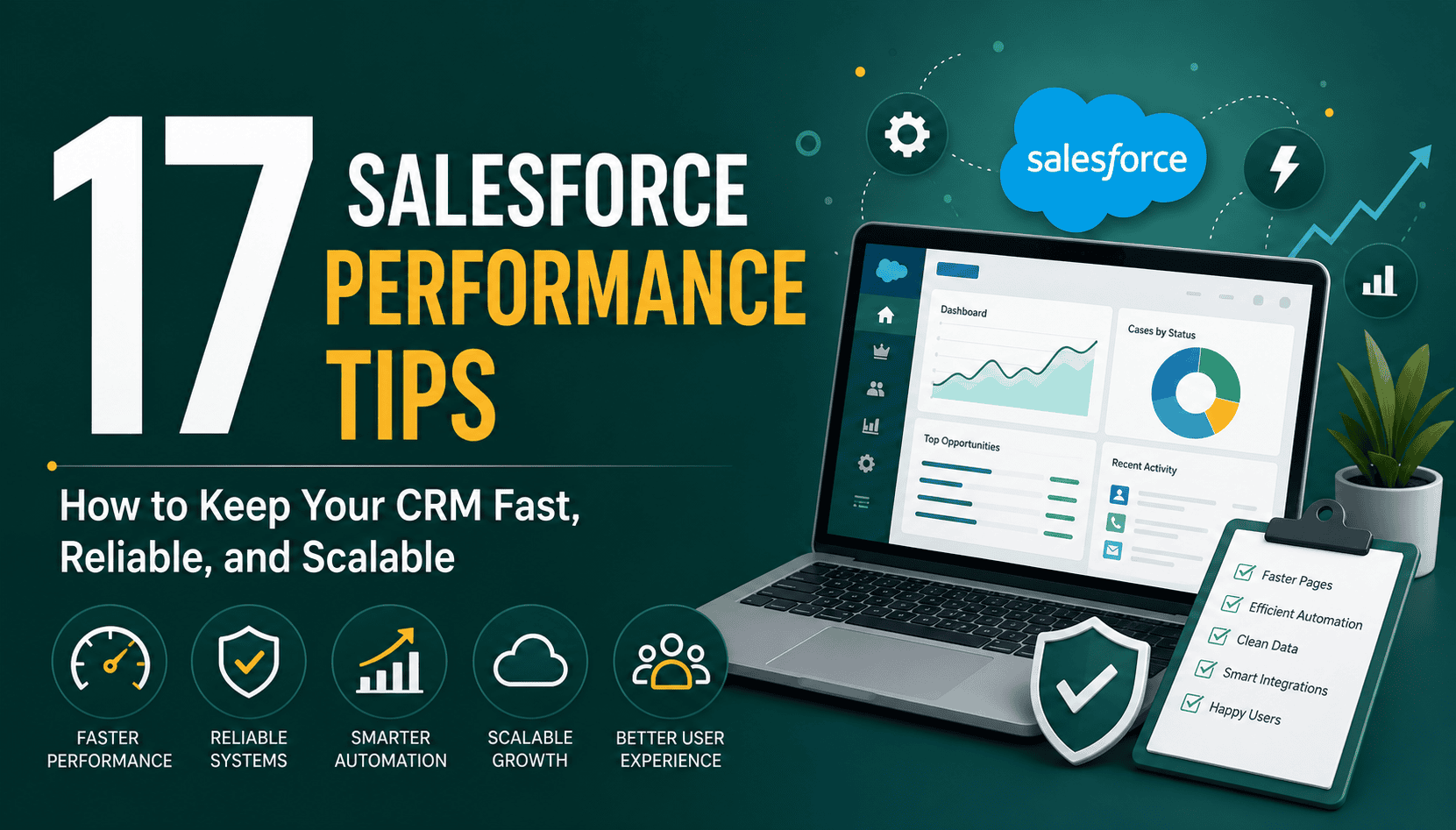
Salesforce performance tips are essential for any business that relies on Salesforce as a daily operating system for sales, service, marketing, reporting, and customer management. A slow Salesforce org affects productivity, user adoption, data quality, automation reliability, and customer experience. Even a powerful CRM can become frustrating when pages take too long to load, reports timeout, automations run inefficiently, or integrations create delays.
The good news is that Salesforce performance can usually be improved with a structured approach. Instead of guessing, you need to examine configuration, data volume, automation, security settings, page design, integrations, reports, and user behavior. This guide explains practical Salesforce performance tips that administrators, developers, consultants, and business teams can use to build a faster and more scalable CRM environment.
Salesforce is often central to business operations. Sales teams use it to manage leads and opportunities, support teams use it to resolve cases, managers use it for forecasting and reporting, and leadership uses it to make strategic decisions. When Salesforce is slow, the impact spreads across the organization.
Poor performance can lead to:
Performance optimization is not only a technical task. It is also a business efficiency issue. A faster Salesforce org helps users complete work with less friction and helps leadership trust the data and workflows inside the system.
Before changing settings or rebuilding automations, start with an audit. Performance problems can come from many sources, so you need to identify where delays occur. Slow performance may be caused by browser issues, network latency, large data volumes, inefficient automation, complex sharing rules, heavy Lightning pages, poor report design, or external integrations.
A useful Salesforce performance audit should review:
If your org has grown over several years, it may contain legacy automations, unused fields, old validation rules, redundant apps, and outdated configuration. These hidden layers can quietly reduce performance over time.
One of the most practical Salesforce performance tips is to simplify Lightning record pages. Many Salesforce orgs become slow because record pages contain too many components, related lists, dynamic forms, embedded reports, third-party widgets, and conditional sections.
Lightning pages should be designed around what users need most often, not every possible piece of information. A crowded page increases load time and makes the user experience harder.
Review each Lightning page and ask whether every component is truly needed. Remove or relocate components that are rarely used. Heavy components such as report charts, custom components, related record lists, and third-party package widgets can increase loading time.
Common page optimization actions include:
Tabs and accordions can improve perceived performance because some components load only when users open them. Place high-priority information in the default visible area and move secondary information into additional tabs.
For example, a sales opportunity page may show key fields, activity history, and next steps immediately. Less frequently used information such as historical notes, extended product details, or admin-only fields can be placed in secondary tabs.
Not every user needs the same page experience. Sales representatives, sales managers, service agents, operations users, and executives may need different information. Assigning Lightning pages by app, profile, or record type can reduce clutter and improve usability.
Role-specific design also helps reduce cognitive load. Users can work faster when the page only shows what is relevant to their job.
Automation is one of Salesforce’s biggest advantages, but poorly designed automation can also be one of the biggest causes of slow performance. Over time, an org may accumulate Workflow Rules, Process Builder processes, Flows, Apex triggers, approval processes, validation rules, and managed package automations that all run on the same record changes.
When too many automations fire at once, users may experience delays when saving records. In severe cases, automation can cause record locking, governor limit errors, or failed transactions.
If your org still relies heavily on Workflow Rules and Process Builder, consider moving toward a cleaner Flow-based automation architecture. However, migration should be planned carefully and tested before production deployment.
Best practices for automation performance include:
Before-save flows are usually faster than after-save flows for simple updates to the same record. If you only need to update fields on the triggering record, a before-save flow can be more efficient.
After-save flows are useful when you need to update related records, create records, send notifications, or perform more complex actions. Using the right flow type helps maintain better performance.
A common performance issue occurs when multiple tools perform similar actions. For example, a Workflow Rule, Process Builder process, Flow, and Apex trigger may all update the same record or related objects. This increases processing time and makes troubleshooting difficult.
Create an automation inventory that documents what runs on each object. Then identify duplicate or conflicting logic. Simplifying automation improves both speed and maintainability.
Large data volumes can affect Salesforce performance, especially in reports, list views, searches, sharing calculations, and automation. Salesforce is built to scale, but data architecture must be planned carefully as your business grows.
Performance issues often appear when objects contain millions of records, when reports query too much historical data, or when integrations create large amounts of unnecessary data.
Not all historical data needs to remain active in Salesforce forever. Consider whether old activities, closed cases, obsolete leads, outdated integration logs, or historical transactional records can be archived.
Archiving can help improve performance by reducing the amount of data users and reports need to process. It also makes the CRM easier to navigate.
For large data volumes, selective queries matter. Reports, list views, Apex queries, and integrations should use indexed fields where possible. Salesforce automatically indexes some standard fields, but custom indexes may be needed in certain scenarios.
Fields often considered for indexing include:
Indexing should be planned carefully. Not every field should be indexed, and filters must still be selective to improve query performance.
Duplicate records make Salesforce harder to use and can slow down searches, reports, and automation. Implement duplicate rules, matching rules, and periodic data cleanup processes. Good data hygiene improves both system performance and business decision-making.
Salesforce reports and dashboards are powerful, but poorly designed reports can become slow. Reports that scan too many records, use broad date ranges, include unnecessary fields, or rely on complex cross-filters can take longer to load.
To improve report performance:
Dashboards should focus on key decision-making metrics. If a dashboard contains too many components or pulls from complex reports, it may load slowly and become less useful.
Salesforce security design can affect performance, especially in large or complex orgs. Role hierarchies, sharing rules, public groups, territories, manual sharing, and account teams all influence record visibility calculations.
A well-designed access model helps Salesforce determine who can see what more efficiently. If your org has a complicated role hierarchy or excessive sharing rules, performance may suffer during record access checks and sharing recalculations.
If you are reviewing your access model, this guide on Salesforce user roles, profiles, and access provides a helpful foundation for understanding how visibility and permissions work together.
Role hierarchies should reflect data visibility needs, not necessarily every detail of the company org chart. Overly deep or complex hierarchies can create maintenance challenges and may contribute to slower sharing recalculations.
Sharing rules are useful, but too many rules can increase complexity. Review sharing rules periodically and remove outdated rules that no longer support current business processes.
Public groups can simplify sharing administration, but they should be organized clearly. Avoid creating overlapping groups without documentation. Poorly managed groups can make troubleshooting access issues more difficult.
Integrations are often essential, but they can also create performance issues if they are not designed properly. Poorly planned integrations may send too many API requests, update records too frequently, create duplicate data, or trigger unnecessary automation.
Common integration-related performance problems include:
For a broader planning framework, review this Salesforce integration guide, which explains integration methods, best practices, and checklist items that can help prevent performance and data quality problems.
For large data operations, bulk APIs and batch processing are usually more efficient than sending many individual requests. However, large batches should be scheduled carefully to avoid disrupting users during peak working hours.
Integrations should only update records when values actually change. Updating records with the same values wastes processing resources and may trigger automation unnecessarily.
Not every integration needs real-time synchronization. Some data can sync hourly, daily, or on a scheduled basis. Choosing the right sync frequency reduces load and improves system stability.
Never make major performance-related changes directly in production without testing. Salesforce sandboxes allow administrators and developers to test automation changes, page redesigns, integrations, and data updates safely before deployment.
A sandbox is especially important when changing Flows, Apex, validation rules, sharing settings, managed packages, or integration behavior. Testing helps prevent unexpected performance issues and business disruption.
If you need to plan a stronger testing process, this Salesforce sandbox guide explains sandbox types, setup considerations, and best practices for safer development and testing.
Performance testing is most useful when the sandbox reflects realistic data volumes. A flow or report may work quickly with 100 records but become slow with hundreds of thousands of records. Full or Partial Copy sandboxes can be helpful when testing large-scale changes.
Ask real users to test updated pages and workflows before releasing changes. A technically optimized page is only successful if it also helps users work faster and more accurately.
Managed packages from AppExchange can extend Salesforce functionality, but too many packages can add complexity. Some packages add custom objects, triggers, Lightning components, permission sets, scheduled jobs, and automation that may affect performance.
Review installed packages periodically and ask:
Removing unused packages can reduce clutter, improve maintainability, and sometimes improve performance. However, package removal should be tested carefully because packages may contain dependencies.
Users often experience performance issues in list views and search results. These issues are commonly linked to broad filters, large data volumes, or unselective queries.
To improve list view performance:
For search performance, make sure users understand how to search effectively. Clean data, consistent naming conventions, and duplicate management all help users find records faster.
Even if Lightning pages are optimized, page layouts can still become overloaded. Too many fields create confusion and slow down user workflows. They also make data quality harder to maintain because users may not know which fields matter.
Review fields regularly and identify:
A cleaner layout helps users save records faster and reduces training complexity. It also supports better reporting because users are more likely to complete the fields that actually matter.
Salesforce performance is not only about what users see on screen. Background processes can also affect system behavior. Scheduled jobs, batch Apex, queueable Apex, platform events, integration syncs, and API calls all contribute to system load.
Monitor:
If many jobs run at the same time, consider staggering schedules. For example, avoid running large imports, dashboard refreshes, integration syncs, and batch jobs during the same peak period.
Salesforce mobile performance matters for field sales teams, service teams, executives, and remote workers. Mobile users often deal with variable network conditions and smaller screens, so page simplicity is even more important.
Mobile optimization tips include:
A mobile layout should focus on the actions users need in the field, such as logging calls, updating opportunities, creating notes, checking account details, or closing service tasks.
Some performance issues are technical, but others come from user behavior. Users may create broad reports, export too much data, use inefficient list views, upload duplicates, or rely on manual workarounds because they do not understand the best way to use Salesforce.
Training should cover:
Performance optimization works best when admins, developers, and users all contribute. Users can often identify slow pages, confusing workflows, and unnecessary steps before they become larger problems.
The best time to optimize Salesforce performance is before problems become serious. New Salesforce implementations should be designed with scalability in mind, including data model planning, automation architecture, integration strategy, role hierarchy design, and reporting requirements.
If your organization is still evaluating Salesforce or planning a new implementation, this article on why businesses choose Salesforce CRM explains the platform’s broader advantages, including scalability, customization, automation, analytics, and integrations.
Scalable Salesforce design includes:
Many Salesforce performance issues develop because changes are made without enough governance. Admins, consultants, developers, departments, and vendors may all add fields, automations, reports, and integrations without a shared long-term plan.
Good Salesforce governance helps prevent performance problems by controlling how changes are requested, reviewed, tested, deployed, and documented.
Before adding a new field, automation, package, or integration, ask:
Documentation helps teams understand how the org works. At minimum, document key objects, automations, integrations, managed packages, sharing rules, permission sets, and deployment processes.
Without documentation, every future change becomes riskier and performance troubleshooting becomes slower.
Salesforce rarely works alone. It often connects with websites, marketing automation tools, ecommerce platforms, customer support systems, analytics tools, accounting software, and data warehouses. The surrounding technology stack can influence Salesforce performance and data quality.
If your business systems are disconnected or poorly planned, Salesforce may receive duplicate, incomplete, or excessive data. A well-planned technology stack helps each system do its job without overloading the CRM. This guide on building a business technology stack for growth can help you think about how Salesforce fits into the wider digital ecosystem.
Use this checklist to identify practical improvement opportunities in your Salesforce org:
Improving performance is not only about adding new solutions. It is also about avoiding common mistakes that make Salesforce slower over time.
Salesforce performance should be reviewed regularly, not only when users complain. The right frequency depends on the size and complexity of your org, but most businesses should conduct at least a quarterly performance review.
Consider more frequent reviews if:
A regular review process helps you catch small issues before they become expensive and disruptive.
Salesforce performance optimization is an ongoing process. A fast and reliable org depends on clean data, efficient automation, thoughtful page design, scalable integrations, simple security architecture, and disciplined governance. The most effective Salesforce performance tips are not isolated tricks; they are part of a larger commitment to keeping your CRM usable, maintainable, and aligned with business goals.
Start with the areas that create the most user frustration: slow record pages, long save times, poor reports, duplicate data, and integration delays. Then build a regular optimization process so Salesforce continues to support your business as it grows.
When Salesforce is designed and maintained well, it becomes more than a database. It becomes a faster, smarter, and more reliable platform for managing customer relationships, improving operations, and supporting long-term growth.