September 10, 2026
Salesforce vs HubSpot: Which CRM Is Best for Your Business?
Salesforce vs HubSpot: Which CRM Is Better for Your Bu...
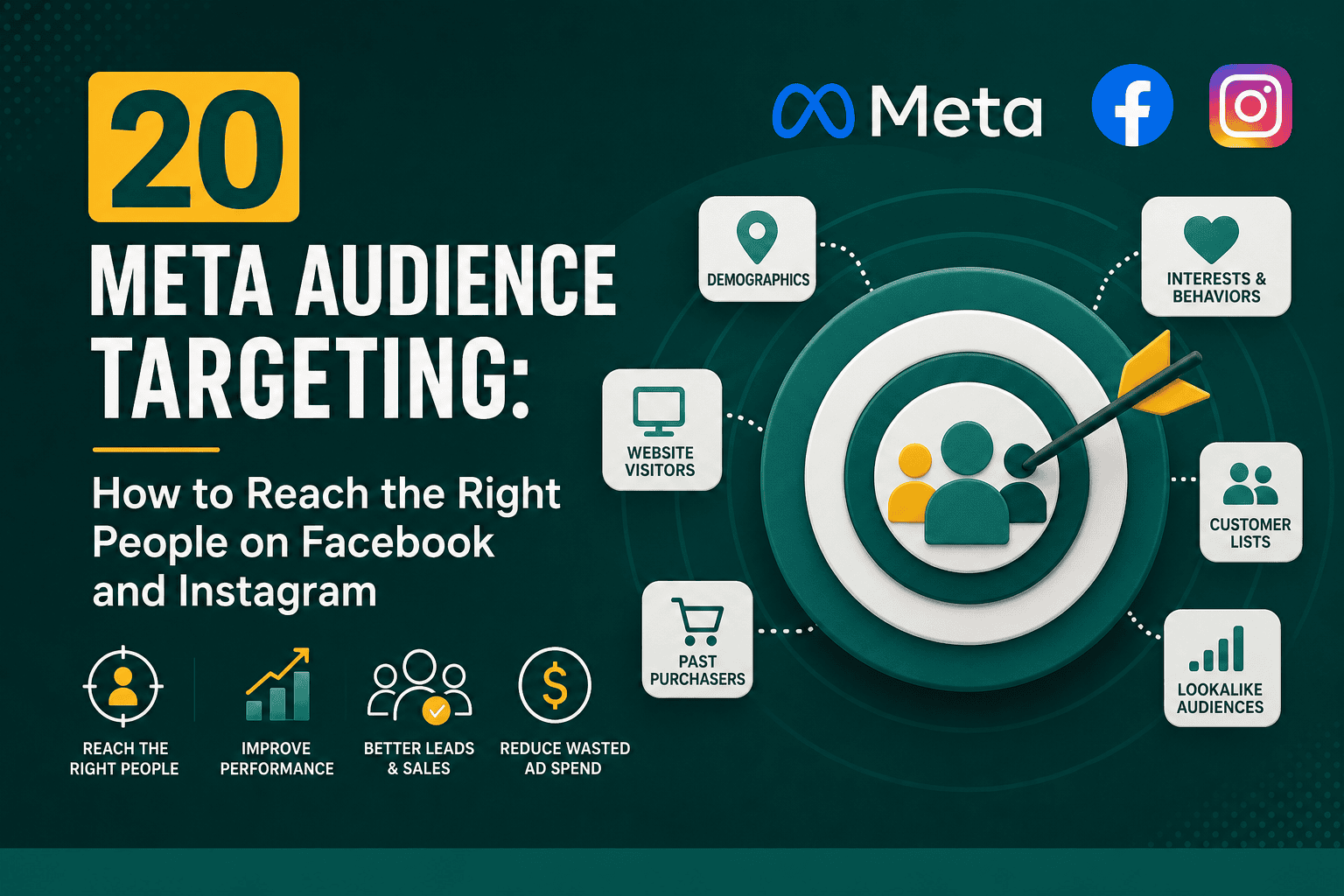
Meta audience targeting is the process of defining who should see your ads across Facebook, Instagram, Messenger, and the Meta Audience Network. Instead of showing ads to everyone, advertisers use audience signals such as demographics, interests, behaviors, website activity, customer lists, engagement history, and algorithmic optimization to reach people who are more likely to take action.
When used properly, meta audience targeting helps businesses reduce wasted ad spend, improve conversion rates, strengthen message relevance, and build a more predictable advertising system. However, targeting on Meta has changed significantly in recent years. Privacy updates, reduced tracking visibility, and Meta’s increased reliance on machine learning mean that successful targeting is no longer just about choosing detailed interests. It is about combining the right audience structure, creative strategy, data quality, campaign objective, and performance analysis.
This guide explains how Meta audience targeting works, the main audience types available, how to structure audiences by funnel stage, common mistakes to avoid, and practical best practices for improving campaign performance.
Meta audience targeting allows advertisers to define the groups of people they want to reach with paid campaigns. These groups can be broad, highly specific, based on existing customer data, or automatically generated by Meta’s algorithm.
For example, a business can target:
The goal is not simply to create a narrow audience. The goal is to give Meta enough relevant signals to find people who are likely to respond to your offer. A strong targeting strategy should be part of a wider digital marketing strategy for sustainable growth, where audience selection, positioning, content, landing pages, and measurement all work together.
Meta has billions of users across its platforms, but not all users are right for your business. Without effective targeting, your ads may reach people who are unlikely to buy, sign up, book a call, or engage meaningfully with your brand.
Strong meta audience targeting helps you:
Meta provides several audience types, each with a different role. Most successful accounts use a mix of broad audiences, custom audiences, and lookalike audiences depending on the campaign objective and available data.
Core audiences are built inside Meta Ads Manager using targeting options such as location, age, gender, language, interests, behaviors, and demographics.
Common core audience targeting options include:
Core audiences can be useful for awareness and prospecting campaigns, but they should not be overcomplicated. Very narrow targeting can restrict delivery, increase costs, and prevent Meta’s algorithm from finding better opportunities.
Custom audiences are built from people who already have some relationship with your business. These are often among the most valuable audiences because they contain warmer prospects or existing customers.
Examples of custom audiences include:
Custom audiences are especially important for retargeting. They allow you to show relevant follow-up messages to users who have already interacted with your brand.
Lookalike audiences help you reach new people who share similarities with an existing source audience. Meta analyzes a source audience, such as customers or high-quality leads, then finds other users with similar characteristics.
Good lookalike source audiences include:
Lookalike audiences can be created at different percentages, such as 1%, 2%, 5%, or 10%, depending on country and audience size. A 1% lookalike is usually more similar to the source audience, while larger percentages provide broader reach.
Advantage+ Audience is Meta’s AI-assisted targeting approach. Instead of relying only on fixed targeting rules, advertisers can provide audience suggestions while allowing Meta to expand beyond them when the system predicts better results.
This can be effective when:
Advantage+ Audience reflects the broader shift in Meta advertising: targeting is increasingly influenced by machine learning, creative signals, conversion data, and landing page behavior rather than manual audience selections alone.
A strong targeting strategy usually maps audiences to the customer journey. Someone discovering your brand for the first time should not always see the same message as someone who visited your pricing page yesterday.
At the top of the funnel, your goal is to introduce your brand, product, or offer to new people. These users may not know you yet, so your messaging should focus on problems, desires, education, and attention.
Useful audience types for top-of-funnel campaigns include:
For this stage, avoid making audiences too narrow. Meta often performs better when it has enough space to test and optimize delivery.
Middle-of-funnel audiences include users who have shown interest but may not be ready to convert. They may have watched a video, engaged with an Instagram post, visited your website, or opened a lead form.
Useful middle-of-funnel audiences include:
Messaging at this stage should build trust. Use testimonials, comparisons, educational content, case studies, product benefits, and answers to common objections.
Bottom-of-funnel audiences are users who have shown strong intent. These people may have added a product to cart, visited a booking page, started checkout, requested information, or returned to your website multiple times.
Useful bottom-of-funnel audiences include:
At this stage, ads should encourage action. Useful messages may include limited-time offers, free consultations, product demonstrations, guarantees, shipping information, urgency, or direct response calls to action.
Your audience strategy should match your campaign objective. If you want purchases, optimize for purchases where possible. If you want leads, optimize for completed lead forms or qualified lead events. If you want awareness, broad reach or video views may be appropriate.
Choosing the wrong objective can weaken your audience targeting because Meta will optimize delivery toward the wrong behavior. For example, a traffic campaign may find people likely to click, but not necessarily people likely to buy.
Broad targeting means limiting manual restrictions and allowing Meta’s delivery system to find likely converters. This approach can work well when the account has enough data, the offer is clear, and conversion tracking is reliable.
Broad targeting is often effective for ecommerce, lead generation, and scalable campaigns because Meta can evaluate user behavior in real time and optimize toward the chosen event.
Retargeting is one of the most practical uses of meta audience targeting. People who already visited your website, engaged with your content, or started a form are usually more familiar with your brand than cold audiences.
Segment retargeting audiences based on intent. For example, a person who watched a short video may need educational content, while someone who abandoned checkout may need reassurance, urgency, or an incentive.
A lookalike audience is only as good as its source audience. Avoid building lookalikes from low-quality traffic or unqualified leads. Instead, use high-intent data such as purchasers, qualified leads, high-value customers, or users who completed meaningful actions.
If your business uses CRM data to define lead quality or customer value, connecting systems can make audience building stronger. A well-planned Salesforce integration strategy, for example, can help align advertising data with sales and customer records so campaigns optimize toward better business outcomes rather than surface-level leads.
Exclusions prevent you from wasting budget on people who should not see a particular ad. For example, you may want to exclude recent purchasers from a prospecting campaign or exclude existing leads from a lead generation campaign.
Common exclusions include:
Use exclusions carefully. Too many exclusions can reduce audience size and limit delivery.
Creative is now one of the strongest targeting signals on Meta. The images, videos, hooks, captions, and offers you use help Meta understand who is likely to respond.
For example, an ad speaking directly to first-time homebuyers will naturally attract a different audience than an ad speaking to real estate investors. An ad for startup founders will attract different engagement than an ad for enterprise executives.
Instead of depending only on manual targeting, create ads that clearly signal who the message is for.
Overly complex campaign structures often make optimization harder. If you create too many small ad sets, each one may struggle to gather enough data. In many cases, fewer campaigns and broader ad sets allow Meta to learn faster.
Audience overlap happens when multiple ad sets target many of the same people. This can cause your own campaigns to compete against each other and make performance harder to interpret.
To reduce overlap:
Retargeting windows should reflect buying behavior. A low-cost ecommerce product may need a short retargeting window, such as 7 to 14 days. A high-ticket service may require 30, 60, 90, or even 180 days depending on the sales cycle.
Examples of retargeting windows include:
Even well-targeted campaigns can decline when audiences become tired of seeing the same ads. Creative fatigue may lead to lower click-through rates, higher costs, and weaker conversion performance.
Refresh creative by testing:
Targeting decisions should be based on performance data, not assumptions. Review metrics such as cost per result, conversion rate, return on ad spend, lead quality, frequency, click-through rate, and funnel progression.
For a complete measurement process, use consistent campaign reporting. A structured Meta ads reporting system helps identify which audiences, creatives, placements, and offers are actually contributing to profitable growth.
Many advertisers assume that narrower targeting is always better. In reality, very small audiences can limit delivery and increase costs. Meta’s algorithm needs enough room to test users and learn from behavior.
Stacking many interests into one ad set can create a broad and unclear audience. If interests are unrelated, the ad set may become difficult to analyze. Use interests strategically, and test only when they represent meaningful audience differences.
Website visitors, customers, email subscribers, and CRM contacts are valuable targeting assets. Businesses that ignore first-party data often rely too heavily on cold audiences and miss opportunities for retargeting and lookalike creation.
If you optimize for clicks, Meta will find people likely to click. If you optimize for leads without checking lead quality, Meta may find people likely to submit forms but not necessarily become customers. Whenever possible, optimize toward events that reflect real business value.
Cold prospects, engaged users, and high-intent visitors should not always receive the same ad. If you use the same message across all audiences, you may lose relevance and waste budget.
Meta campaigns need enough time and data to stabilize. Pausing or changing audiences too quickly can disrupt the learning phase and prevent the algorithm from optimizing properly.
Privacy updates have changed how advertisers track and target users. Browser restrictions, cookie limitations, iOS privacy changes, and user consent requirements can reduce visibility into website behavior and conversions.
To improve data reliability, advertisers should focus on:
As tracking becomes less complete, Meta audience targeting depends more heavily on first-party data, strong creative, clear conversion events, and post-click analysis.
Ecommerce brands can use meta audience targeting to reach new buyers, retarget product viewers, recover abandoned carts, and promote repeat purchases.
Useful ecommerce audiences include:
Service businesses can use audience targeting to reach people with specific needs, retarget website visitors, and nurture users who engaged with educational content.
Useful service business audiences include:
B2B targeting on Meta can be more challenging because professional intent is often harder to identify than consumer intent. However, Meta can still work well for B2B when the creative, offer, and funnel are aligned.
Useful B2B targeting approaches include:
For companies using CRM platforms as a central customer database, understanding why businesses choose tools like Salesforce can also help connect advertising initiatives with sales operations, pipeline visibility, and customer management. This is especially relevant for organizations evaluating Salesforce CRM for business growth.
Audience testing should be structured, not random. The goal is to identify meaningful differences in performance and understand what drives results.
A simple audience testing process may look like this:
To understand whether your audience targeting is working, monitor both platform metrics and business metrics.
Important Meta Ads metrics include:
If an audience has a low cost per lead but poor sales quality, it may not be a good audience. If another audience has a higher lead cost but better close rates, it may be more profitable. This is why advertising data should be connected to real business results whenever possible.
Here is a simple framework you can use when planning campaigns:
Meta audience targeting is no longer just about selecting interests and demographics. The most effective advertisers combine broad algorithmic targeting, high-quality first-party data, custom audiences, lookalikes, funnel-specific messaging, strong creative, and reliable reporting.
To get better results, start with a clear campaign objective, build audiences around user intent, avoid unnecessary complexity, and measure performance beyond surface-level metrics. When your targeting strategy is aligned with your offer, creative, data, and business goals, Meta can become a powerful channel for reaching the right people and converting them into customers.