September 10, 2026
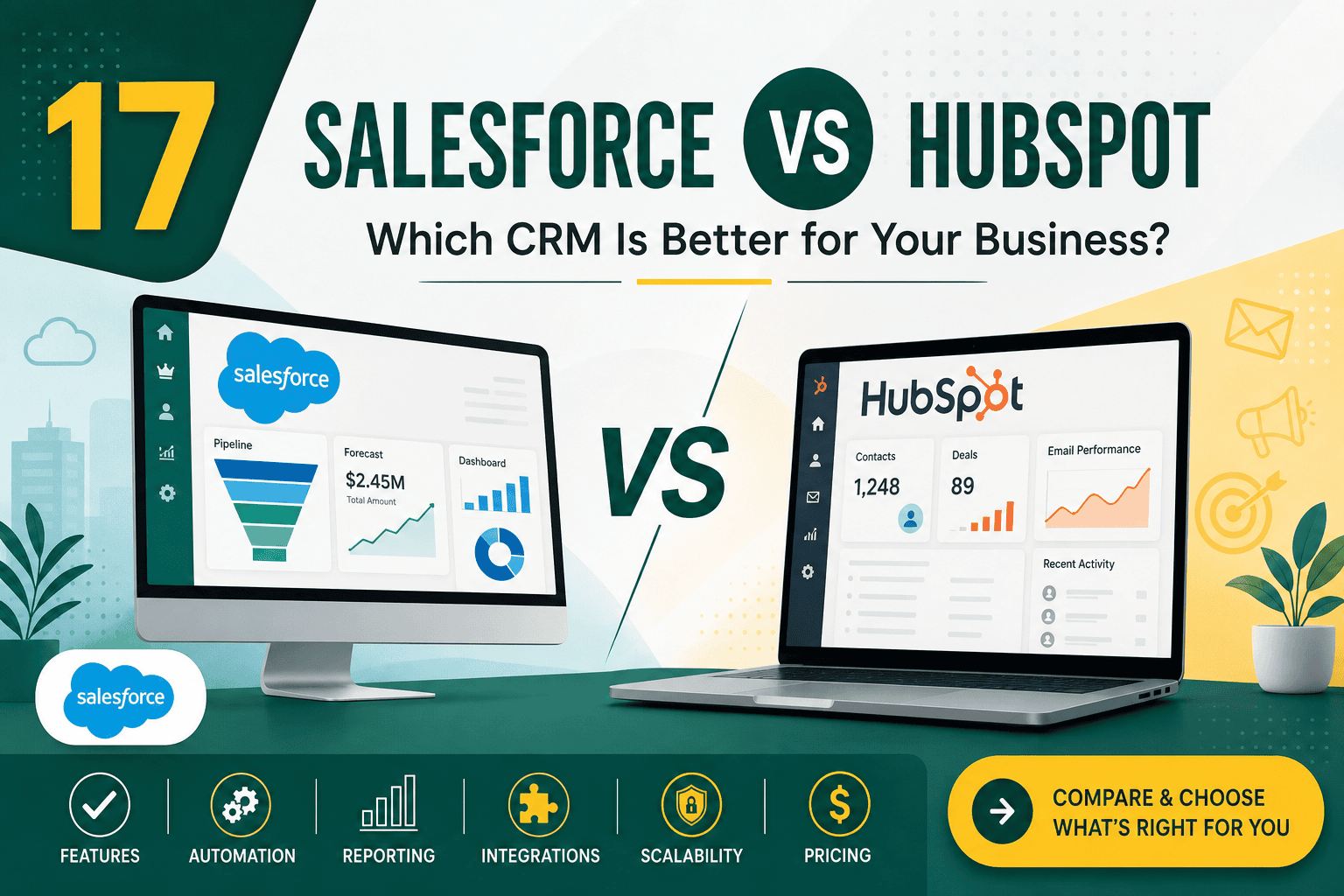
Salesforce vs HubSpot: Which CRM Is Best for Your Business?
Salesforce vs HubSpot: Which CRM Is Better for Your Bu...
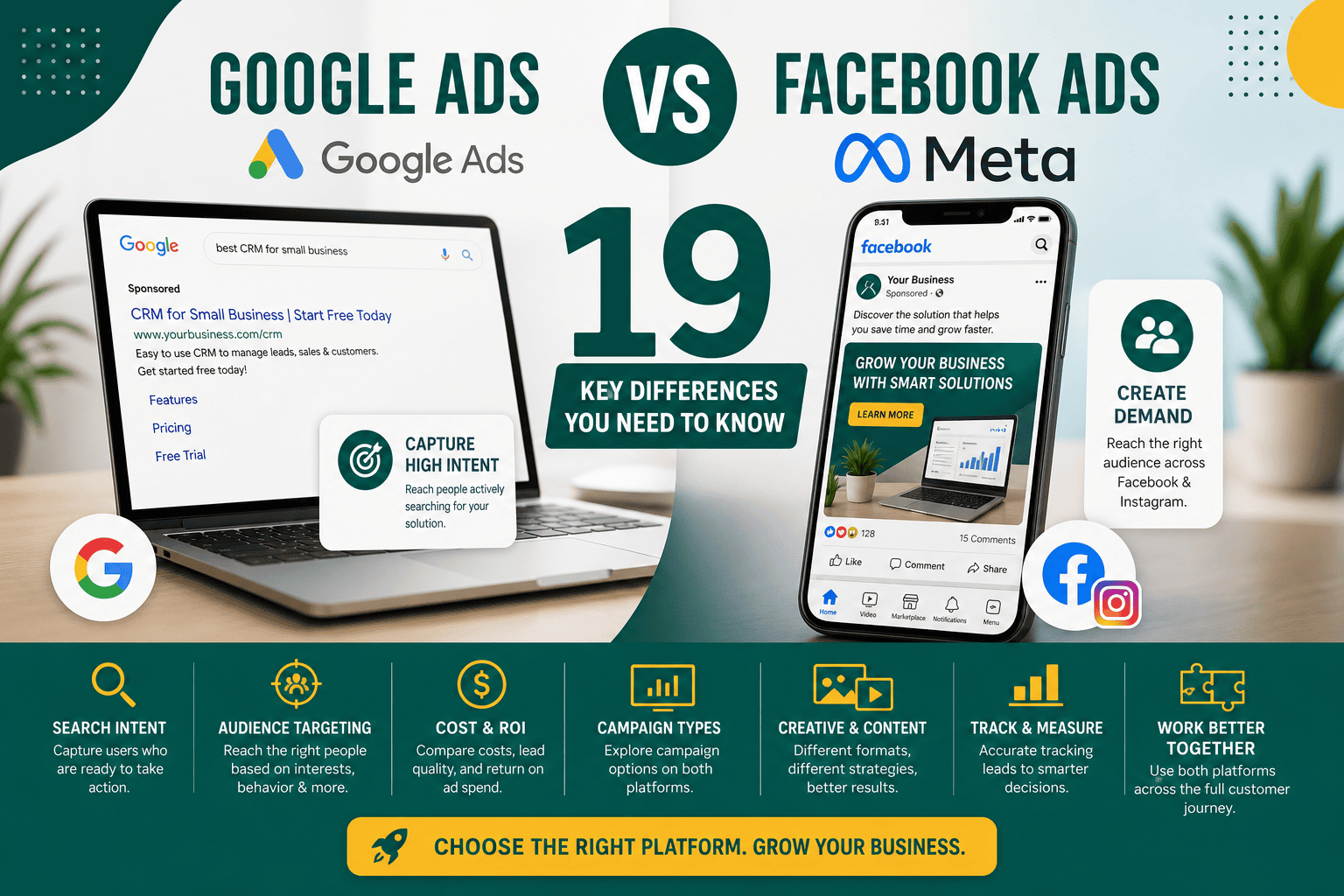
Choosing between Google Ads vs Facebook Ads is one of the most common decisions businesses face when planning paid advertising. Both platforms can generate leads, sales, traffic, and brand awareness, but they work in very different ways. Google Ads is strongest when people are actively searching for a product, service, or solution. Facebook Ads, now part of Meta Ads, is strongest when you want to reach specific audiences based on interests, behaviors, demographics, and engagement across Facebook and Instagram.
The best choice is not always one platform over the other. In many cases, the best advertising strategy uses both: Google Ads to capture existing demand and Facebook Ads to create demand, nurture audiences, and stay visible throughout the buying journey. The right decision depends on your goals, budget, industry, offer, sales cycle, creative assets, and tracking setup.
The simplest way to compare Google Ads and Facebook Ads is this: Google Ads is intent-based advertising, while Facebook Ads is audience-based advertising.
With Google Ads, you show ads to people based on what they are searching for. If someone types “emergency plumber near me,” “best CRM for small business,” or “buy running shoes online,” they are already expressing intent. This makes Google Ads powerful for capturing users who may be close to taking action.
With Facebook Ads, you show ads to people based on who they are, what they are interested in, how they behave online, and how they interact with your business. Instead of waiting for someone to search, you can place your offer in front of a targeted audience while they browse Facebook, Instagram, Messenger, Reels, Stories, and other Meta placements.
Google Ads is Google’s advertising platform that allows businesses to run paid campaigns across Google Search, YouTube, Gmail, Google Maps, the Display Network, Shopping results, and partner websites. The most common format is the search ad, where advertisers bid on keywords and appear when users search for related terms.
Google Ads can be used for lead generation, ecommerce sales, app promotion, local service campaigns, brand awareness, remarketing, and video advertising. However, its biggest advantage is the ability to reach users when they are actively looking for something.
If your goal is to build high-intent search campaigns, a detailed search campaign guide for Google Ads can help you understand campaign structure, keyword targeting, ad copy, landing pages, and conversion-focused setup.
Facebook Ads are part of Meta Ads, the advertising platform used to run campaigns across Facebook, Instagram, Messenger, and the Meta Audience Network. Advertisers can target users by demographics, interests, behaviors, custom audiences, lookalike audiences, engagement, website visits, and customer lists.
Facebook Ads are especially effective for visual storytelling, brand awareness, lead generation, ecommerce remarketing, community building, and introducing new products or services to people who may not be actively searching yet.
Because targeting is one of Meta’s biggest strengths, understanding Meta audience targeting for Facebook and Instagram is important if you want to reach the right people without wasting budget on broad or poorly defined audiences.
| Factor | Google Ads | Facebook Ads |
|---|---|---|
| Main strength | Capturing search intent | Targeting audiences and creating demand |
| User mindset | Actively searching for a solution | Browsing social content and discovering offers |
| Best for | High-intent leads, local services, ecommerce, urgent needs | Awareness, retargeting, visual products, lead nurturing |
| Targeting method | Keywords, location, audience signals, placements | Demographics, interests, behaviors, custom and lookalike audiences |
| Creative needs | Mostly text, landing pages, product feeds, videos for YouTube | Strong images, videos, hooks, ad angles, and social proof |
| Buying intent | Usually higher | Often lower at first, but strong for nurturing and remarketing |
| Learning curve | Keyword strategy, bidding, tracking, landing pages | Creative testing, audience strategy, tracking, offer positioning |
Google Ads is often the better choice when people are already searching for what you sell. If your customers clearly know their problem and use Google to find solutions, Google Ads can put your business in front of them at the right moment.
Google Ads works very well for industries such as legal services, home repair, dental clinics, medical services, B2B software, consultants, accountants, real estate services, insurance, and local businesses. If people search for your service with commercial intent, search ads can be highly effective.
For example, a user searching “roof repair company near me” is much closer to taking action than someone casually scrolling through Instagram. In this case, Google Ads can capture demand that already exists.
If your campaigns, landing pages, and conversion tracking are set up correctly, Google Ads can start generating leads quickly. You do not need to wait months for SEO rankings or organic reach. You can bid on relevant keywords and start collecting data almost immediately.
However, fast traffic does not automatically mean profitable traffic. A proper account review using a Google Ads audit checklist can help identify wasted spend, poor keyword targeting, weak conversion tracking, and campaign structure issues that reduce return on ad spend.
Google Ads performs best when users know what they want. Examples include “buy office furniture,” “Salesforce consultant,” “emergency AC repair,” “best ecommerce development agency,” or “CRM implementation service.” These searches show clear intent and can be matched with relevant landing pages.
Google Ads traffic often performs best when it lands on a focused, relevant page. The landing page should match the search query, explain the offer clearly, build trust, and make the next step easy. Sending paid traffic to a generic homepage usually reduces conversion rates.
Facebook Ads is often better when your product or service benefits from visual explanation, storytelling, emotional appeal, audience education, or repeated exposure. It is also powerful when people may not know they need your solution yet.
Not every product or service has strong search volume. Some offers are new, highly visual, impulse-driven, or difficult for users to search for because they do not yet know the solution exists. Facebook Ads can introduce these offers to relevant audiences before they begin searching.
Facebook and Instagram are visual platforms. Your results often depend heavily on images, videos, hooks, captions, testimonials, demonstrations, and offers. A good Facebook ad feels native to the platform while still communicating a clear value proposition.
Facebook Ads can be very effective for staying in front of people who visited your website, watched your videos, engaged with your page, opened a lead form, added products to cart, or interacted with your Instagram profile. This makes it useful for nurturing prospects who are not ready to buy immediately.
Fashion, beauty, fitness, food, home decor, coaching, courses, events, and lifestyle products often perform well on Facebook and Instagram because they can be presented visually. Strong creative can generate interest even before the user has searched for the product.
Facebook Ads often has a lower cost per click than Google Ads, but that does not always mean it is cheaper in terms of customer acquisition. Google Ads clicks can be more expensive because they often come from users with stronger buying intent. Facebook Ads clicks may cost less, but users may need more nurturing before converting.
The real question is not which platform has the cheapest clicks. The better question is: which platform gives you the lowest profitable cost per lead, sale, booked call, or customer?
A platform with higher click costs can still be more profitable if the traffic converts better. A platform with cheaper clicks can become expensive if the leads are low quality or do not close.
Google Ads and Facebook Ads both offer targeting options, but they begin from different starting points.
Google Ads starts with user intent. The user searches, watches, browses, or interacts within the Google ecosystem, and advertisers match ads based on keywords, audience signals, location, device, demographics, and behavior.
Facebook Ads starts with audience identity and behavior. You define the type of person you want to reach, and Meta shows ads across Facebook and Instagram based on demographic, interest, engagement, and behavioral signals.
Google Ads and Facebook Ads require different creative approaches. A text search ad on Google needs to match user intent quickly. A Facebook ad needs to interrupt the scroll, earn attention, and create interest.
For Google Search, ad copy should be direct, relevant, and aligned with the keyword. The user already has intent, so your job is to show that your offer matches their need. Strong headlines, clear benefits, trust signals, pricing details, offers, and calls to action can improve performance.
For YouTube, Display, Shopping, and Performance Max, visuals also matter. However, search campaigns are still heavily driven by keyword relevance, landing page quality, and conversion intent.
Facebook Ads creative usually needs more testing. The advertiser must test different hooks, videos, images, formats, copy lengths, angles, testimonials, user-generated content, and offers. Since users are not always actively looking to buy, your creative must explain why they should care.
Common Facebook creative angles include:
Accurate tracking is essential for both Google Ads and Facebook Ads. Without proper conversion tracking, both platforms may optimize toward the wrong actions, and your reports may not reflect true business performance.
Google Ads relies on conversion actions such as form submissions, calls, purchases, booked appointments, downloads, and offline conversions. For better measurement, advertisers should also consider enhanced conversions, especially when browser restrictions and privacy changes affect tracking accuracy. A practical enhanced conversions guide can help improve Google Ads measurement by sending hashed first-party data in a privacy-conscious way.
Facebook Ads relies on the Meta Pixel, Conversions API, event tracking, custom conversions, aggregated event measurement, and platform-reported attribution. Tracking quality can significantly affect campaign learning, optimization, and reporting accuracy.
Because Meta reporting can differ from Google Analytics, CRM data, or ecommerce platform data, businesses should understand how to interpret results using a structured approach to Meta Ads reporting and campaign analysis.
Lead quality varies by industry, offer, targeting, landing page, form design, and follow-up process. In general, Google Ads often produces higher-intent leads because users are actively searching. Facebook Ads may produce more affordable leads, but some may require more education and nurturing.
Google Ads leads often have stronger immediate intent. Someone searching for a specific service is more likely to be comparing providers, requesting quotes, or preparing to buy. However, competitive keywords can be expensive, and broad match targeting without careful management can attract irrelevant traffic.
Facebook Ads can generate a high volume of leads, especially through instant forms, but quality can vary. Low-friction forms may produce more leads but fewer qualified prospects. Higher-intent website forms, qualifying questions, and strong follow-up workflows can improve lead quality.
Both platforms can work well for ecommerce, but they play different roles.
Google Shopping, Performance Max, and Search campaigns are strong when shoppers search for specific products or categories. If someone searches for “buy leather laptop bag” or “best standing desk under 500,” Google Ads can place your products directly in front of them.
Facebook and Instagram Ads are strong for product discovery, visual storytelling, retargeting, and impulse purchases. A user may not search for your product, but a strong video, carousel, or testimonial ad can create interest and drive purchases.
For B2B companies, Google Ads is often strong when prospects are actively searching for solutions, vendors, consultants, software, or services. Search terms such as “Salesforce implementation partner,” “managed IT services,” or “CRM automation consultant” can indicate meaningful intent.
Facebook Ads can still work for B2B, but it usually needs a different strategy. Instead of going directly for a sales call, businesses may promote guides, webinars, case studies, lead magnets, video content, or remarketing campaigns. Facebook can help educate buyers and stay visible, especially when the sales cycle is longer.
Google Ads is often the stronger starting point for local businesses because people frequently search for nearby services. Examples include restaurants, dentists, plumbers, electricians, clinics, lawyers, gyms, salons, and repair services.
Facebook Ads can support local businesses by promoting offers, events, testimonials, seasonal campaigns, and community awareness. It can also retarget website visitors and reach people within a defined geographic radius.
Facebook Ads is usually stronger for broad brand awareness because it allows visual storytelling and cost-effective reach across Facebook and Instagram. You can introduce your brand to new audiences even when they are not searching.
Google can also support awareness through YouTube, Display, and Performance Max, but search campaigns are typically better suited for intent capture than broad discovery.
In many cases, yes. Google Ads and Facebook Ads often work better together than separately. They support different stages of the customer journey.
Facebook Ads can introduce your brand to new audiences, educate prospects, and build remarketing pools. Google Ads can capture people when they later search for your brand, product category, competitors, or solution. Google can also bring in high-intent traffic, while Facebook retargets those visitors with testimonials, offers, and reminders.
This combined approach works best when it is part of a clear digital marketing strategy for sustainable growth that connects paid ads with landing pages, analytics, CRM follow-up, email nurturing, SEO, and conversion optimization.
Your ad budget should depend on your goals, market, average sale value, conversion rate, and customer lifetime value. A small local business may start with a modest daily budget, while a high-ticket B2B or ecommerce brand may need a larger budget to collect enough data.
Cheap clicks do not always create profitable customers. Expensive clicks are not always bad if they convert into high-value sales. Focus on business outcomes, not vanity metrics.
Paid traffic usually performs better when sent to a relevant landing page. The page should match the ad, answer user objections, include proof, and make conversion easy.
Without tracking, you cannot confidently know which campaigns, keywords, ads, or audiences are producing results. Both platforms need accurate conversion data to optimize effectively.
Facebook Ads performance often depends on creative testing. One image or video is rarely enough. Test different hooks, offers, formats, messages, and proof points.
Broad keyword targeting can work, but it must be managed carefully. Without negative keywords, conversion data, and search term analysis, broad targeting can waste budget.
Paid ads can generate leads, but your follow-up process determines whether those leads become customers. Slow response times, weak qualification, and poor CRM management can make good campaigns look unprofitable.
Use the following questions to decide which platform should be your priority:
| Business Type | Recommended Starting Platform | Reason |
|---|---|---|
| Emergency local services | Google Ads | Users search with urgent intent. |
| Visual ecommerce products | Facebook Ads and Google Shopping | Meta creates discovery; Google captures product searches. |
| B2B services | Google Ads | Search intent can indicate active vendor evaluation. |
| New product with low search volume | Facebook Ads | Meta can create demand before people search. |
| High-ticket coaching or consulting | Both | Facebook can nurture; Google can capture high-intent searches. |
| Restaurants and events | Facebook Ads | Visual promotion and local awareness are important. |
| Software and SaaS | Both | Google captures solution searches; Facebook supports education and retargeting. |
Google Ads is usually better when you want to capture people who are already searching for your product, service, or solution. It is especially strong for high-intent leads, local services, ecommerce searches, and B2B demand capture.
Facebook Ads is usually better when you want to create demand, reach specific audiences, use visual storytelling, build awareness, and retarget people across Facebook and Instagram. It is especially strong for ecommerce, lifestyle products, lead nurturing, and offers that benefit from repeated exposure.
The best platform depends on where your customers are in the buying journey. If they are actively searching, prioritize Google Ads. If they need to discover, understand, or be reminded of your offer, prioritize Facebook Ads. If your budget allows, use both platforms together with accurate tracking, strong landing pages, consistent creative testing, and performance reporting focused on real business results.