September 29, 2026
Salesforce Implementation Cost: Complete Pricing Guide
Salesforce Implementation Cost: Complete Pricing Guide...
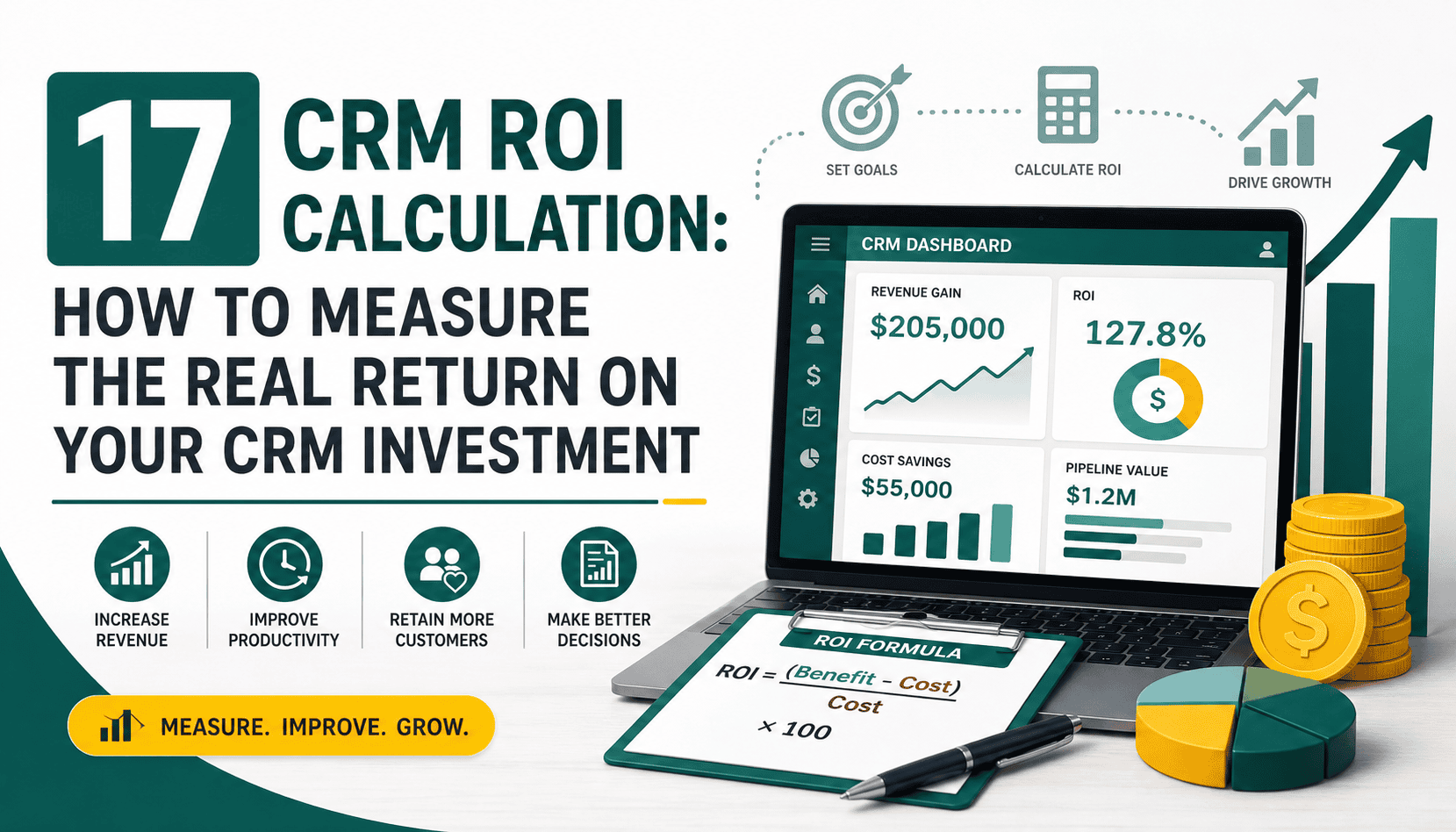
CRM ROI calculation is the process of measuring whether your customer relationship management system is producing more financial value than it costs. A CRM can help your business increase sales, improve follow-up, automate manual work, retain customers, and make better decisions, but those benefits need to be measured clearly if you want to understand its true return on investment.
Many businesses buy a CRM because they know they need better organization, reporting, and customer visibility. However, the value of a CRM depends on how well it is implemented, adopted, customized, automated, and maintained. A simple license cost comparison is not enough. To calculate CRM ROI properly, you need to compare the total cost of ownership against measurable revenue gains, cost savings, productivity improvements, and customer retention benefits.
This guide explains how CRM ROI calculation works, which costs and benefits to include, which formulas to use, and how to improve CRM return over time.
CRM ROI means customer relationship management return on investment. It measures the financial return your business gets from using a CRM compared with the total amount spent on the system.
In simple terms, CRM ROI answers this question:
For every dollar we spend on CRM, how much value do we get back?
A positive CRM ROI means your CRM is generating more value than it costs. A negative CRM ROI means the system is costing more than the measurable benefits it produces, at least during the period being measured.
CRM ROI can come from several areas, including:
If you are still defining what CRM should do for your business, it may help to review the fundamentals of what CRM is and how it works before building your ROI model.
The standard CRM ROI calculation is:
CRM ROI = ((CRM Financial Benefit – CRM Cost) / CRM Cost) × 100
For example, if your CRM generated $120,000 in measurable benefit and cost $40,000 over the same period:
(($120,000 – $40,000) / $40,000) × 100 = 200% ROI
This means the CRM returned two dollars in net gain for every dollar spent.
The formula is simple, but the quality of your CRM ROI calculation depends on how accurately you define costs and benefits.
A common mistake is calculating CRM ROI based only on software subscription fees. In reality, CRM cost includes every expense required to plan, implement, customize, use, support, and improve the system.
This includes monthly or annual CRM subscription costs for all users. Pricing may vary by edition, user type, feature set, storage limits, and add-ons.
Examples include:
Implementation costs are often one of the largest parts of CRM investment. These may include discovery, strategy, configuration, data migration, automation setup, integrations, testing, training, and launch support.
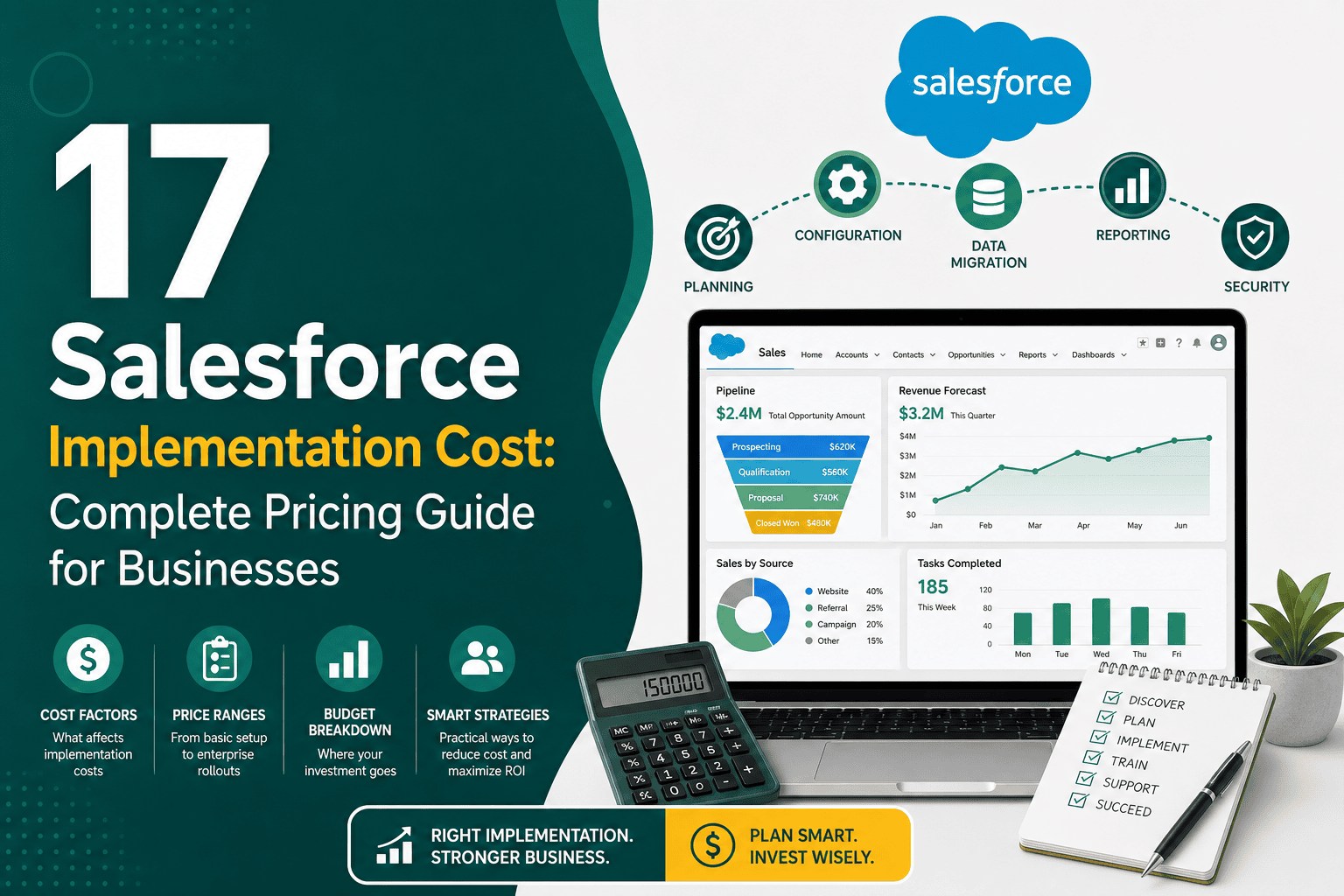
If you are evaluating Salesforce specifically, this Salesforce implementation cost guide explains the main pricing factors that affect total project cost.
CRM data migration may require exporting data from old systems, cleaning duplicates, standardizing fields, mapping records, importing data, and validating accuracy. If your existing data is messy, the cleanup work can be significant.
Clean data directly affects CRM ROI because poor data causes bad reporting, missed follow-ups, duplicate work, and unreliable automation. A structured CRM data cleanup process can improve both adoption and measurement accuracy.
Most businesses need some level of customization to make the CRM match their sales process, customer lifecycle, service workflow, reporting needs, and approval rules.
Customization costs may include:
CRM becomes more valuable when it connects with other business systems. However, integrations can add upfront and ongoing costs.
Common CRM integrations include:
A CRM only creates value if people use it correctly. Training costs may include workshops, documentation, video training, admin coaching, role-specific onboarding, and ongoing support.
Change management is also important. If teams resist the CRM, avoid data entry, or keep working from spreadsheets, ROI will be lower.
CRM systems need ongoing care. This may include user support, field updates, workflow adjustments, dashboard improvements, data monitoring, bug fixes, access management, and process changes.
Ongoing admin work should be included in your CRM ROI calculation, whether it is handled internally or by an outside consultant.
During implementation, employees may spend time in planning sessions, testing, training, and process redesign. That time has a cost. For a more advanced CRM ROI calculation, include the internal labor hours spent on CRM adoption and management.
CRM benefits should be measured in financial terms whenever possible. Some benefits are direct, such as increased revenue. Others are indirect, such as time saved or better reporting. The best CRM ROI calculation includes both.
The most obvious CRM benefit is revenue growth. A CRM can help sales teams manage leads better, prioritize opportunities, follow up faster, and close more deals.
Revenue gains may come from:
If your CRM helps convert more leads into customers, that improvement can be converted into financial value.
For example:
In this case, improved lead conversion creates $120,000 in annual revenue benefit.
A CRM can reduce the time it takes to move prospects from first contact to closed deal. Faster sales cycles improve cash flow and allow sales teams to handle more opportunities.
Shorter sales cycles may result from:
CRM productivity gains happen when sales reps spend less time on manual admin and more time selling. This can be measured by estimating hours saved and multiplying by employee cost.
For example:
CRM can help businesses retain more customers by improving communication, renewal tracking, support visibility, and proactive account management.
Retention improvements are especially valuable for subscription businesses, service companies, B2B firms, and any business with repeat customers.
For example:
A CRM can improve marketing ROI by helping teams understand which campaigns produce qualified leads, customers, and revenue. Instead of judging marketing by clicks or form fills alone, CRM reporting connects campaigns to pipeline and closed deals.
For businesses measuring marketing performance across channels, a strong marketing analytics framework can make CRM ROI calculation more accurate.
For service teams, CRM ROI may come from faster case resolution, fewer repeated issues, better knowledge base usage, and improved customer satisfaction.
Service-related CRM benefits may include:
Accurate CRM reporting helps leaders make better decisions about sales, staffing, marketing budget, customer service, forecasting, and operations. While reporting value is harder to quantify, it can be estimated by measuring time saved and improvements from better decisions.
CRM dashboards are especially important for tracking ROI because they make performance visible. A practical CRM dashboards guide can help you decide which metrics to monitor.
Use the following process to calculate CRM ROI in a structured and realistic way.
Choose the time period you want to measure. Common CRM ROI periods include:
CRM ROI is often lower in the first year because implementation costs are higher. ROI usually improves in later years as upfront costs decrease and adoption increases.
Add every CRM-related cost for the period.
Example annual CRM costs:
Total CRM cost: $90,000
Identify measurable revenue improvements that can reasonably be connected to CRM usage.
Example revenue gains:
Total revenue gain: $150,000
Estimate operational savings from reduced manual work, better automation, and improved efficiency.
Example cost savings:
Total cost savings: $55,000
Add revenue gains and cost savings.
Total CRM benefit = Revenue gains + Cost savings
$150,000 + $55,000 = $205,000
CRM ROI = ((CRM Benefit – CRM Cost) / CRM Cost) × 100
(($205,000 – $90,000) / $90,000) × 100 = 127.8%
In this example, the CRM generated a 127.8% return during the measurement period.
You can use this simple template to organize your own calculation:
Total CRM Cost: $_____
Total CRM Benefit: $_____
CRM ROI = ((Total Benefit – Total Cost) / Total Cost) × 100
To calculate ROI accurately, you need the right CRM metrics before and after implementation. These metrics act as your baseline and performance indicators.
For a broader list of performance indicators, review these CRM KPIs every business should track.
Imagine a small B2B service company invests in a CRM to improve lead management, sales follow-up, and reporting.
Total cost: $40,000
Total benefit: $118,000
(($118,000 – $40,000) / $40,000) × 100 = 195%
This means the CRM produced a 195% return in the first year.
Now imagine a company with 20 sales reps uses CRM automation to reduce admin work and improve pipeline management.
Total cost: $125,000
Total benefit: $496,400
(($496,400 – $125,000) / $125,000) × 100 = 297.1%
In this case, most of the ROI comes from a combination of productivity savings and revenue improvement.
The time it takes to see CRM ROI depends on company size, CRM complexity, data quality, implementation quality, user adoption, and how quickly the system supports revenue-generating work.
Typical CRM ROI timelines:
First-year ROI may be reduced by implementation and migration costs. Second-year ROI is often stronger because the business continues receiving benefits while major one-time costs decrease.
CRM license fees are only one part of the investment. Ignoring implementation, training, data work, integrations, and admin time makes ROI look artificially high.
A technically well-built CRM can still fail if users do not adopt it. Poor adoption leads to incomplete data, weak reporting, and limited automation value.
Not every revenue improvement should automatically be credited to the CRM. Use reasonable assumptions and compare performance against a reliable baseline.
If you do not capture baseline metrics before launching the CRM, it becomes harder to prove improvement later.
Implementation, migration, and initial training are often one-time costs. Licenses, admin, support, and optimization are recurring costs. Separating them helps you understand first-year ROI compared with long-term ROI.
Bad data reduces CRM value. Duplicate contacts, missing fields, outdated records, and inconsistent naming can make reports unreliable and automation ineffective.
If your CRM ROI is lower than expected, the solution is not always replacing the platform. Often, ROI improves when the system is better aligned with business goals, workflows, and user needs.
CRM ROI depends heavily on adoption. Make the CRM easier to use, reduce unnecessary fields, train users by role, and show teams how the system helps them do their jobs better.
Automation is one of the fastest ways to improve CRM ROI. Automate lead assignment, follow-up reminders, lifecycle stage updates, email notifications, renewal alerts, task creation, and reporting workflows.
Better data improves reporting, segmentation, automation, and customer experience. Create rules for required fields, duplicate prevention, naming conventions, and regular data review.
Dashboards should help leaders and teams make decisions quickly. Focus on pipeline health, revenue, conversion rates, activity quality, campaign performance, and customer retention.
Your CRM should reflect how your business actually sells. Define clear lead stages, opportunity stages, qualification criteria, required activities, and exit rules for each pipeline step.
When marketing activity connects with CRM revenue data, you can invest more in campaigns that generate real customers and reduce spend on channels that only produce low-quality leads.
CRM ROI calculation should not be a one-time exercise. Review performance quarterly or at least annually. Look for new automation opportunities, reporting gaps, adoption issues, and process bottlenecks.
For sales teams, CRM ROI is usually measured through increased revenue, improved conversion rates, shorter sales cycles, and higher productivity.
Key sales ROI questions include:
For marketing teams, CRM ROI comes from better attribution, improved lead quality, stronger segmentation, and clearer campaign revenue tracking.
Key marketing ROI questions include:
For service teams, CRM ROI comes from faster support, better case tracking, improved customer satisfaction, and reduced churn.
Key service ROI questions include:
For executives and managers, CRM ROI comes from better visibility, forecasting, accountability, and decision-making.
Key leadership ROI questions include:
A good CRM ROI depends on your industry, sales cycle, implementation cost, team size, and business model. However, a CRM should generally produce a positive return within a reasonable period, especially if it is central to sales, marketing, and customer service operations.
As a rough guide:
Be careful when comparing your ROI to generic benchmarks. A complex enterprise CRM may take longer to show returns but provide large long-term value. A smaller business CRM may show faster ROI because the upfront investment is lower.
CRM ROI calculation helps you understand whether your CRM is truly improving business performance. The basic formula is simple: compare total CRM benefits against total CRM costs. The deeper work is identifying realistic costs, measuring meaningful benefits, and tracking the right metrics over time.
A strong CRM return usually comes from more than software. It comes from clean data, better processes, user adoption, useful dashboards, smart automation, and continuous improvement. When your CRM is aligned with how your business sells, markets, serves customers, and makes decisions, it can become one of the most valuable systems in your company.
To improve CRM ROI, start with a clear baseline, measure the right KPIs, include all costs, quantify both revenue gains and efficiency savings, and review performance regularly. The businesses that get the best return from CRM are usually the ones that treat it not as a database, but as a growth system.